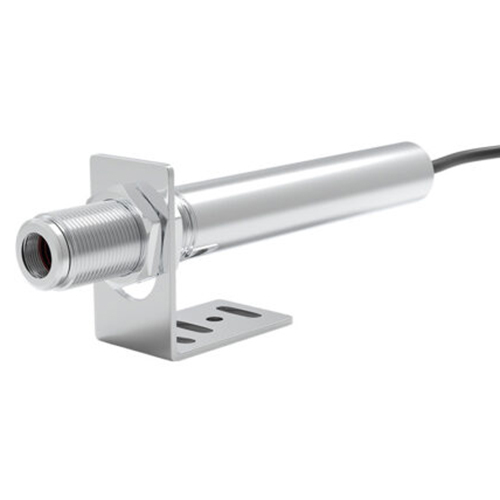
An Infrared (IR) Pyrometer is a non-contact temperature measurement instrument that determines the surface temperature of an object by detecting the intensity of thermal radiation (infrared energy) it emits. It is widely used in industrial settings where direct contact is impossible, dangerous, or would contaminate the target, such as in metal smelting, glass manufacturing, and machinery monitoring.
Key Features & Components
Non-Contact Operation: Measures from a distance, making it safe for extremely hot or hazardous environments.
Optical System: A lens focuses the IR energy from the object onto a detector.
Detector: Converts the radiation into an electrical signal (often a thermopile or photodiode).
Signal Processing: Internal electronics analyze the signal, applying emissivity settings to calculate the temperature, which is displayed digitally.
Laser Targeting: Most models include a laser pointer to identify the center of the target area.
Fast Response: Provides nearly instant readings, often in milliseconds.
Working Principle
Emission: All objects with a temperature above absolute zero emit infrared radiation.
Detection: The pyrometer's lens collects this radiation and focuses it onto a detector.
Conversion & Processing: The detector converts the energy into an electrical signal. The device applies an emissivity factor (the efficiency of the material in emitting energy) to calculate the actual temperature.
Display: The result is shown on a screen or transmitted to a control system.
Types of IR Pyrometers
Portable (Handheld) Pyrometers: Battery-operated "guns" used for quick, spot checks and maintenance.
Fixed (Online) Pyrometers: Permanently mounted on production lines for continuous, real-time monitoring.
Single-Wavelength (Monochromatic): Measures radiation at one wavelength; best for materials with stable, known emissivity.
Two-Color (Ratio) Pyrometers: Measures at two different wavelengths to calculate the ratio, making them more accurate in environments with smoke, dust, or variable emissivity.
Fiber Optic Pyrometers: Use a fiber optic cable to separate the sensor head from the electronics, ideal for high-ambient heat or electromagnetic interference.
Common Applications
Metallurgy: Monitoring molten metal, welding, and heat treatment (annealing/tempering).
Glass Manufacturing: Measuring temperature during forming, bending, and sealing.
Cement & Ceramics: Monitoring kiln temperatures.
Electronics: Checking for hot spots on circuit boards.
Automotive/Aerospace: Testing engine exhaust, braking systems, and turbine blades.
Safety: 24/7 monitoring of hazardous assets to prevent fires.
Key Considerations for Use
Emissivity: The most critical factor; surfaces with low emissivity (e.g., polished metal) are harder to measure accurately.
Distance-to-Spot Ratio (D:S): Determines the size of the area being measured relative to the distance. A 10:1 ratio means at 10 inches away, the spot size is 1 inch.
Atmospheric Interference: Smoke, steam, or dust between the pyrometer and the target can cause errors.
Tell us about your requirement
Price:
Quantity
Select Unit
50
100
200
250
500
1000+
Additional detail
Mobile number
Email
Name
Comapny Name
Phone Number
Email Id
City / State
Confirm Your Requirement
Verification Code
Did not receive yet?
Resend OTP
You’re Done!
We have received your requirements and will reply shortly with the best price.
Products You May Like
More Products in Other Process Instruments Solution Category

 Send Inquiry



 Send Inquiry

 Send Inquiry